

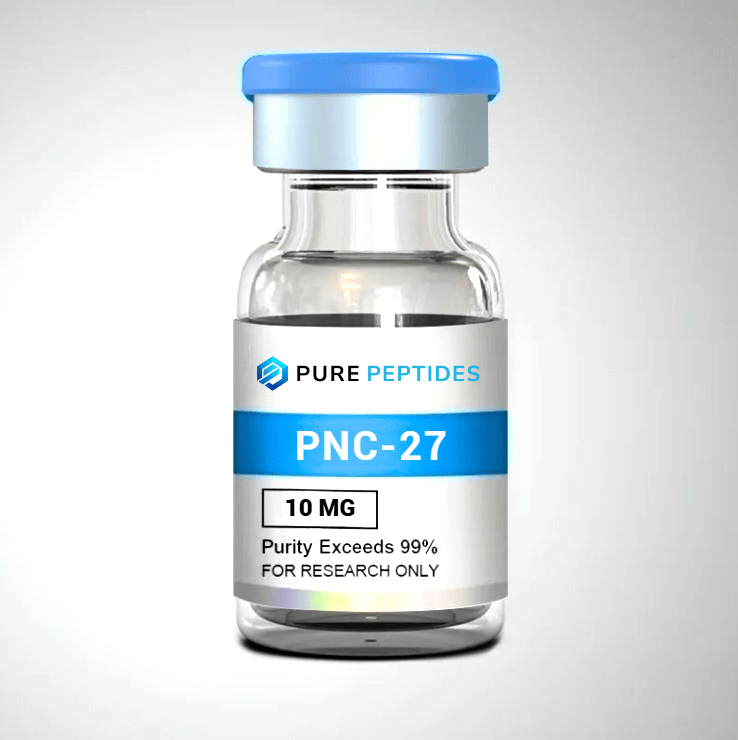
PNC-27
Overview
PNC-27 is a synthetic peptide engineered to selectively target and induce necrosis in cancer cells while leaving healthy, normal cells unaffected. Comprising 32 amino acids, PNC-27 belongs to the PNC family of investigational proteins and is designated exclusively for research purposes. It functions by binding to HDM-2, a protein overexpressed in the membranes of cancer cells, where it triggers transmembrane pore formation, resulting in cell necrosis. Notably, this mechanism operates independently of p53 activity, positioning PNC-27 as a valuable asset for researchers investigating cancer cell death pathways, tumor biology, and the role of HDM-2 in oncogenesis. Its ability to selectively eliminate cancer cells offers a promising avenue for exploring innovative cancer treatment strategies without the widespread cellular damage typical of conventional therapies.
Detailed Benefits Analysis
The potential benefits of PNC-27 are outlined below, derived from preclinical research, and are intended for educational and investigative use:
Anticancer Activity
- Selective Cytotoxicity: PNC-27 exhibits strong cytotoxicity across multiple cancer cell lines, including pancreatic, breast, leukemia, melanoma, and ovarian cancers. It achieves this by inducing necrosis through membrane disruption, providing a direct approach to cancer cell elimination.
- Rapid Cell Death: Research demonstrates that PNC-27 can achieve near-complete cell death in specific cancer cell lines within minutes to hours, as evidenced by lactate dehydrogenase (LDH) release, a key indicator of membrane rupture.
Selective Targeting
- Cancer-Specific Action: By binding to HDM-2, which is predominantly expressed in the membranes of transformed cells, PNC-27 targets cancer cells with high specificity, sparing normal tissues. This selectivity is a critical feature for advancing targeted therapy research.
- Unaffected Normal Cells: Studies confirm that PNC-27 has minimal impact on non-cancerous cells, such as primary human fibroblasts and pancreatic acinar cells, highlighting its potential as a model for precision cancer treatments.
Mechanism of Action
- HDM-2 Binding: PNC-27 incorporates a p53-derived sequence (residues 12-26) that binds to HDM-2 in cancer cell membranes, initiating pore formation and leading to membranolysis and necrosis.
- p53-Independent Pathway: Unlike therapies dependent on functional p53, PNC-27 remains effective in p53-null or mutated cells, expanding its relevance across diverse cancer models.
Potential for Combination Therapy
- Synergistic Effects: Early research suggests that PNC-27 may enhance the effectiveness of other treatments, such as paclitaxel, by targeting cancer cells resistant to initial therapies. This property makes it a candidate for studies on overcoming drug resistance in cancer.
Limitations and Ongoing Research
- Although PNC-27 demonstrates significant potential in preclinical settings, its efficacy and safety in humans are still under evaluation. It is not approved for clinical use, and additional research is required to fully elucidate its therapeutic scope and possible limitations.
Important Note
This product is strictly intended for research purposes and is not approved for human consumption. It is not designed to diagnose, treat, or prevent any medical conditions. Users must comply with all applicable local regulations when handling this research chemical.
Structure
-
PNC-27
- Sequence: H-Pro-Pro-Leu-Ser-Gln-Glu-Thr-Phe-Ser-Asp-Leu-Trp-Lys-Leu-Leu-Lys-Lys-Trp-Lys-Met-Arg-Arg-Asn-Gln-Phe-Trp-Val-Lys-Val-Gln-Arg-Gly-OH
- Molecular Formula: C₁₈₈H₂₉₃N₅₃O₄₄S
- Molecular Weight: 4031.72 g/mol
- PubChem CID: Not available (as it is a synthetic peptide)
- PNC-27 is a 32-amino acid peptide featuring a p53-derived HDM-2 binding domain (residues 12-26) fused to a transmembrane-penetrating sequence, enabling selective disruption of cancer cell membranes.
Loading...